Sphere of influence
The SOI database that keeps working after the deal closes
Most agents' best year comes from people they already know, and most CRMs are organised around transactions — so the moment a sale completes, the person behind it stops being a live record. ProspectKeeper makes the client the record and the deal an event on it, which is what lets a past client still be somebody you are working.
The file that closes when the deal does
You close in June. The transaction is marked complete, the file goes quiet, and the person — who has just had the single largest financial experience of their decade, and who knows twenty other people about to have the same one — becomes a row in a list nobody opens. Two years later they sell through somebody who sent a text in October. Nothing was lost through carelessness. The system simply had no concept of a client you are not currently selling anything to.
Why ProspectKeeper for this
All of it ships today on ProspectKeeper Connect at $99/month — and the pipeline itself is free to start on, for as long as you like.
A contact can exist with no deal at all
The person is the record. They can sit in your database for three years with no transaction attached and still carry notes, history, a stage and a next follow-up, because being worth following up is not conditional on being mid-sale.
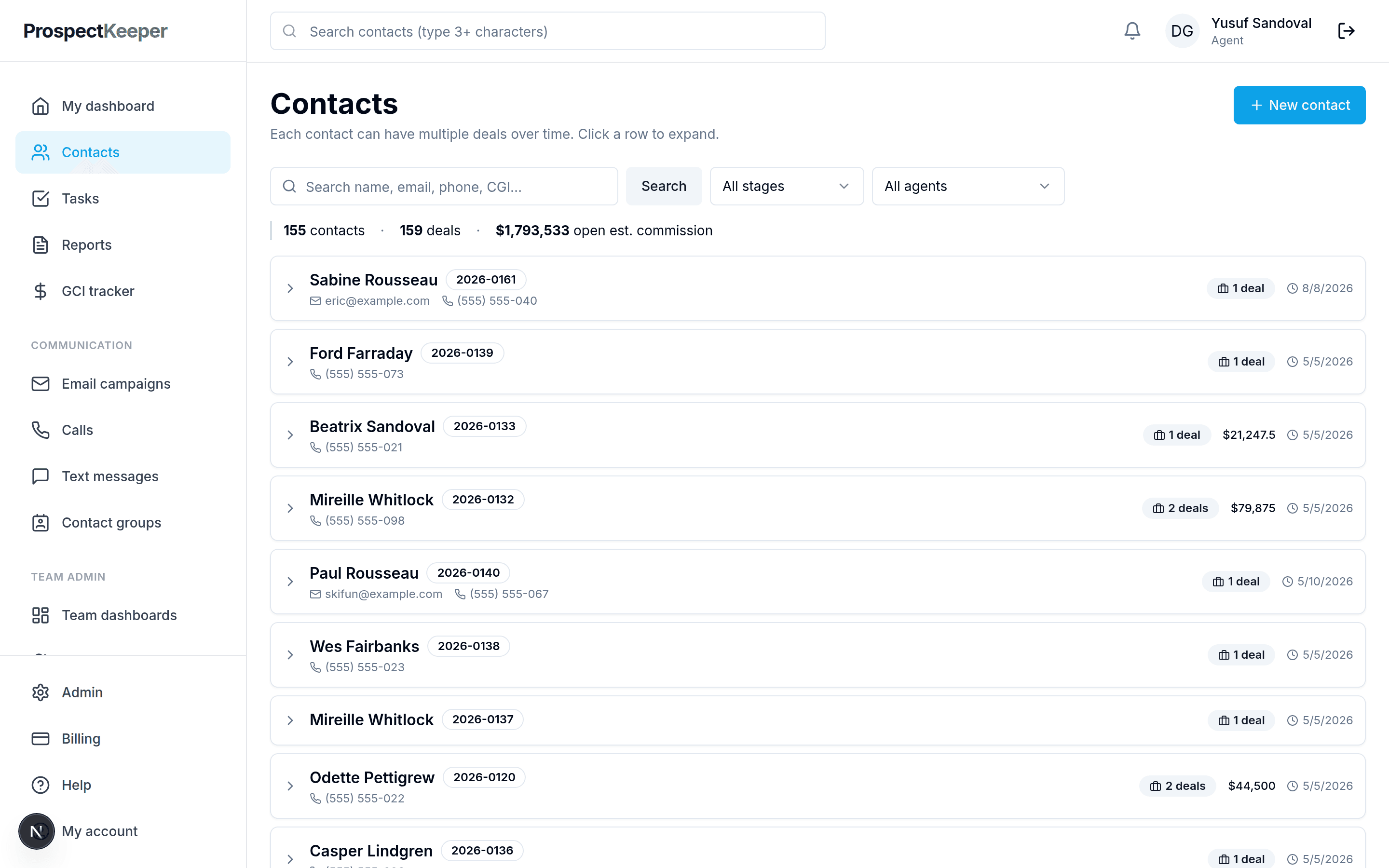
Past Client is a stage you work, not an archive
Closing moves a client to Past Client rather than out of the pipeline. They keep a follow-up date, they appear on the tasks list when it comes due, and they stay in the reports — so the part of the business everyone agrees matters most is the part the software actually shows you.
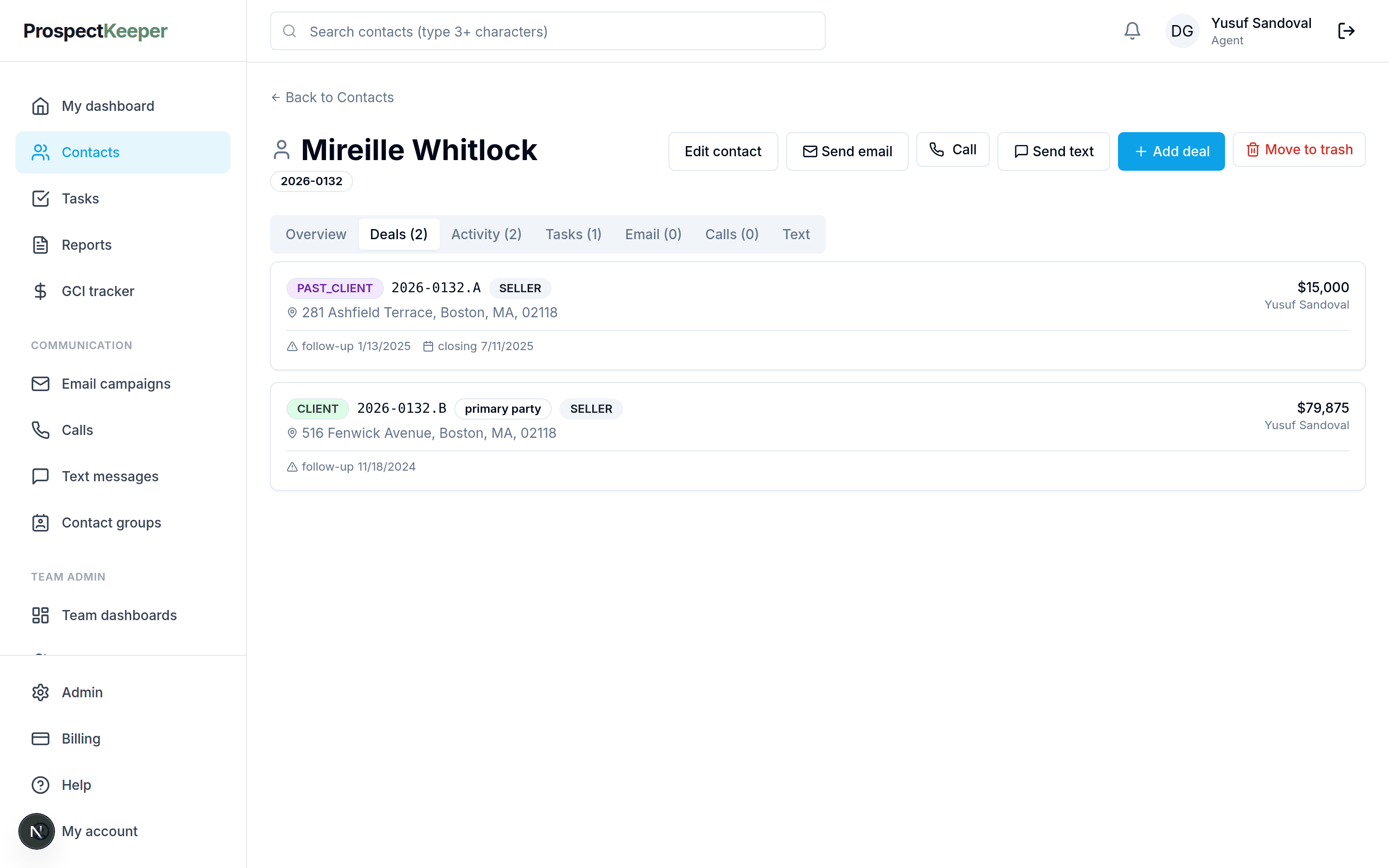
Repeat business opens beside the sale you already made
A second transaction is a new deal on the same person, taking the next filing letter. The old sale, the notes and the conversation history sit right next to it, so you walk into the listing appointment knowing what they said last time rather than what the file says.
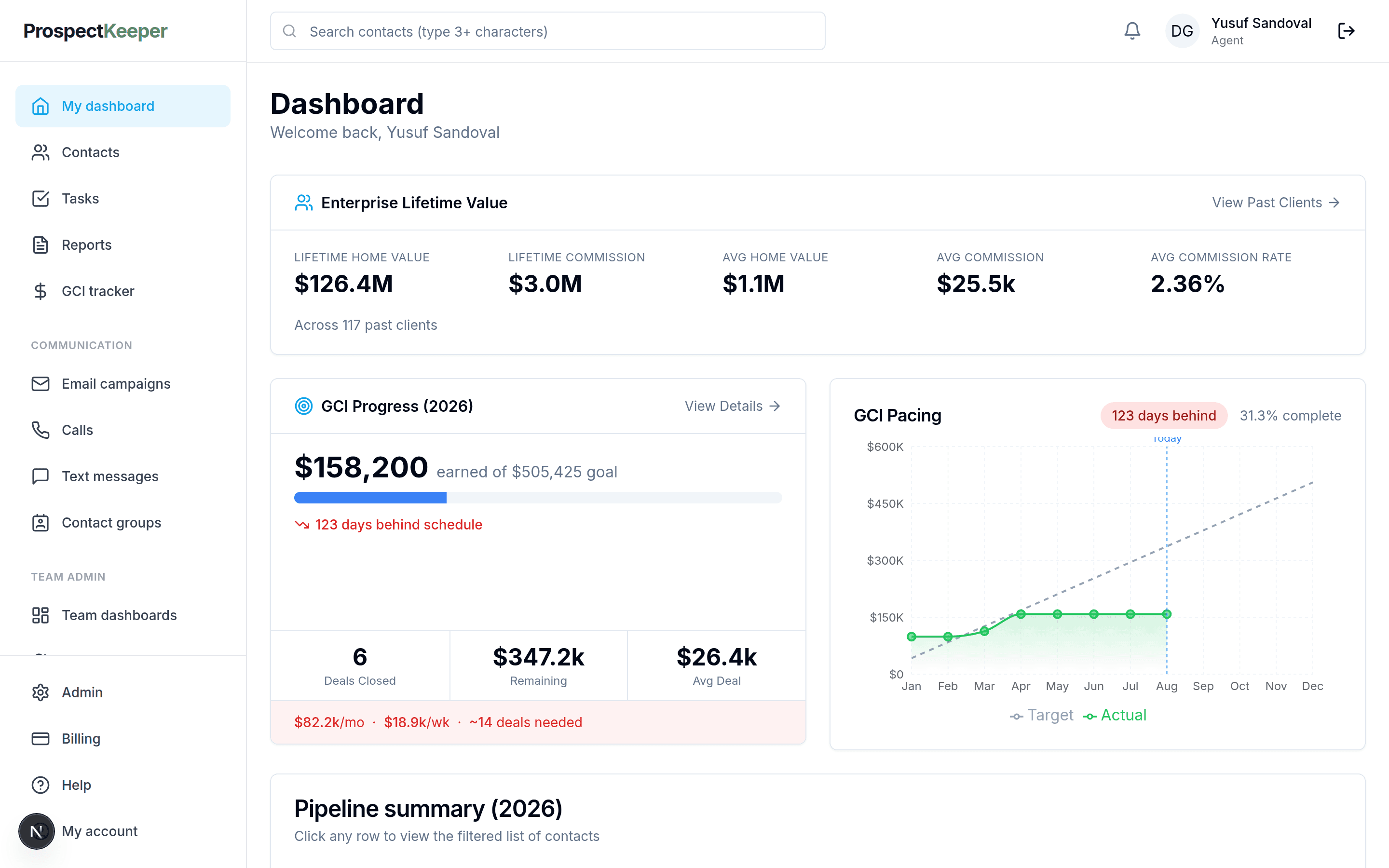
The value of the sphere, counted
Lifetime value across past clients — total home value transacted, commission earned and average rate — sits on the dashboard, so the database has a number attached to it rather than being a thing you are told to nurture.
How it works
From nothing set up to using it on a Tuesday.
Put the people in, deal or no deal
Add everyone you would help move a house — past clients, the people who referred them, the ones who are three years out. A record needs a person, not a transaction.
Give each of them a stage and a date
A stage says what this relationship is; a follow-up date says when you next owe them something. Between them they turn a list of names into a queue you can work.
Work the queue from the tasks screen
Today, upcoming and overdue, each naming its client and its owner. The SOI work competes for attention with everything else rather than living in a document you look at in January.
Reach them from the record
Call, text or send a campaign from the client's file. Whatever you did shows up on their history, so next time you can see when you last actually spoke rather than guessing.
Close, and keep going
A completed deal moves the client to Past Client and leaves the file open. The next follow-up is set on a person you have now done business with, which is the most valuable kind of record in the database.
What you stop maintaining separately
The sphere usually lives outside the CRM — in a phone's contacts, a holiday-card spreadsheet and someone's memory — precisely because the CRM was built around deals. Making the person the record puts it back in one place.
The past-client spreadsheet
Past clients are a stage in the pipeline with follow-up dates, not a separate tab.
The phone's contact list
Notes, history and next actions live with the person, where a colleague can also see them.
The annual pop-by list
Follow-ups come due through the year on the tasks screen instead of arriving all at once.
Guessing what the database is worth
Lifetime value across past clients is counted rather than asserted.
What it does not do
Worth knowing before you spend a week moving in. A switcher finds these in the first fortnight anyway, and hearing them from us first is cheaper for everyone.
- A sphere list comes in from a spreadsheet; there is no enrichment service that fills in the gaps in it for you.
- There is no automated nurture sequence that works the sphere for you — follow-ups are dates you set, and the product surfaces them when they are due.
- There is no relationship scoring or predictive "likely to move" model.
- There is no MLS connection, so a past client's later listing does not appear on its own.
Questions
What is a sphere of influence, in CRM terms?
It is everyone who would plausibly use you or refer you — past clients, friends, colleagues, the people they introduced you to. In ProspectKeeper they are ordinary contacts with a stage and a follow-up date, which is the point: they sit in the same system as your live pipeline instead of in a separate list you look at twice a year.
Can I keep someone in the database with no deal attached?
Yes — that is the default. A contact is a first-class record with its own notes, history, stage and next follow-up, and a deal is something that may or may not happen on it. Most of a healthy sphere has no open transaction at any given moment.
What happens to a client when their deal closes?
They move to the Past Client stage and stay in the pipeline. The file stays open, the history stays attached, and the next follow-up is set on someone who has now actually bought or sold with you.
How do repeat transactions get filed?
As a new deal on the same person, taking the next letter after the last one — 2026-0132.A, then .B. Letters are never reused, so years later the sequence still reads correctly and the earlier sale is right there beside the new one.
Can I see what my past clients have been worth?
Lifetime value across past clients is on the dashboard: total home value transacted, commission earned and the average rate behind it. It is the figure that makes the case for spending time on the sphere instead of only on new leads.
Does it track who referred whom?
Referrals are recorded on the client record and the referral side is available on a deal, so the person who sent you business is attached to the business they sent. There is no automatic referral tree or payout calculation today.
Read next
Try it against your own pipeline
Free to start. Set up your company, add your clients and work the list.